Why water is the whole problem
Expansive clay changes volume with moisture. It does not change volume with load, temperature or age in any way that matters. If the moisture content of the soil around and under a house stayed constant, the house would not move.
The damaging condition is specifically uneven moisture. When one elevation is saturated and another has dried and contracted, the wet side heaves while the dry side settles, and the difference between them is what the structure has to absorb. That is why a leaking downspout at one corner can do more damage than a drought affecting the whole site evenly.
There is a second property of Blackland clay that catches people out. USDA-NRCS documentation for the Houston Black series records that water enters it rapidly when it is dry and cracked, and very slowly once it is moist. So a long dry spell opens fissures; the first heavy rain pours straight down them and swells the soil from below, fast and unevenly; and then the surface seals and subsequent rain runs off instead of soaking in. The background on foundation repair across Texas covers the regional variation in this.
Grading and surface water
The ground should fall away from the house on every elevation. The usual guidance is a drop of roughly six inches over the first ten feet. Over time grading flattens or reverses — soil settles, mulch accumulates, flower beds are built up, patios are added — and water begins collecting against the foundation instead of leaving.
What to look for after heavy rain, which is the only time you can really assess this: water standing within a few feet of the house, soil visibly saturated against the brick for hours afterwards, mulch or soil washed against the wall, and beds that hold water. Fixing grading is usually earthwork rather than construction, and it is among the cheapest interventions available.
A specific Texas trap: flower beds built directly against the foundation, edged to retain soil, and irrigated on a lawn schedule. That arrangement holds moisture against one elevation continuously while the opposite side of the house dries out, which is precisely the differential that moves slabs.
Gutters and downspouts
A roof concentrates an enormous volume of water into a few discharge points. A downspout emptying at the base of the foundation delivers, repeatedly, exactly the concentrated soaking most likely to cause localised heave.
Downspouts should discharge well clear of the foundation — extensions carrying water several feet out, or underground piping to a suitable outfall. Both work; both need to actually discharge somewhere that drains, rather than into a buried pipe that has silted up.
Gutters also have to be clear to function. Overflowing gutters dump water directly against the wall along their whole length, which is worse than having no gutters at all.
French drains and subsurface drainage
Where surface grading cannot move water away — a flat lot, a neighbour's land draining toward you, or a persistently wet area — subsurface drainage intercepts it instead.
A French drain is a trench containing a perforated pipe in washed gravel, wrapped in filter fabric to keep fines out, routed to an outfall that is genuinely lower than the drain. Water entering the soil reaches the gravel, enters the pipe and leaves.
Two things determine whether it works for twenty years or two. The outfall must be lower and must stay clear, because a French drain with nowhere to discharge is a buried trench full of water. And the filter fabric must be correctly specified and installed, because a drain that silts up is effectively gone and cannot be cleaned.
On Blackland clay there is a particular reason these matter: once saturated, the clay accepts almost no further water, so runoff has nowhere to go on a flat lot. Interception before saturation is the whole game.
Watering a foundation during drought
This is counter-intuitive to many homeowners and it is genuinely important. Since the soil cannot be kept dry, the goal is keeping it evenly moist year-round, including through drought.
Placement. The Foundation Performance Association, which publishes foundation maintenance guidance for Texas clay, calls for watering at least a foot out from the wall. Lines are commonly found four to six inches off the brick, where water pools at the base of the foundation beam rather than soaking the soil that carries the load. Beyond roughly 24 inches the moisture may never reach that soil at all. Twelve to eighteen inches is the practical target.
Consistency. Irregular watering is worse than none, because it creates exactly the swings that move clay. Winter is not an off-season — reduce frequency, do not stop.
How to tell if you have it right. Push a screwdriver six inches into the soil on all four sides of the house. In easily and out clean means the moisture is about right. Powdery and hard to penetrate means water more. Muddy means back off. Skip a cycle after meaningful rain.
Soaker hose or drip line. A soaker hose is far better than nothing and cheap to deploy. Its limits are real: distribution is uneven along its length, it has no pressure compensation, and UV exposure degrades it within a few years. Pressure-compensating subsurface drip distributes evenly and lasts, at higher installation cost. Municipal guidance exists too — the City of Denton publishes its own homeowner guide to watering a concrete foundation.
Watering restrictions
Drip irrigation and soaker hoses are commonly exempt from the spray-irrigation day restrictions that apply during drought, though the rules are set by your water provider and vary. Check with them rather than assuming either way.
Trees and landscaping
A mature tree draws a great deal of moisture out of the soil within its root zone, and on expansive clay that localised drying can shrink soil beneath a nearby foundation. The effect is most pronounced during drought, when the tree is drawing hardest and rainfall is not replacing it.
This does not mean removing trees near houses, and removing a large established tree can cause its own problems as the soil it had been drying slowly rehydrates and swells. Where a tree is implicated, root barriers and targeted irrigation are usually the better route, and it is worth getting an opinion that accounts for both the foundation and the tree.
Keeping consistent soil moisture also discourages roots from aggressively seeking water close to the slab, which is a secondary benefit of a properly placed foundation watering line.
Crawl space moisture
For pier and beam homes, moisture does a second kind of damage: it rots the wood. Standing water under the house, bare soil evaporating into the enclosed space, blocked ventilation and no vapour barrier together account for most of the decayed beams and sill plates found under older Texas houses.
A vapour barrier over the crawl space soil is one of the highest-value items available, and it works alongside the exterior drainage described above rather than instead of it.
The two images below show below-grade drainage components — an exterior damp-proof coating and an interior sump pump. They are included for completeness, with a caveat worth stating plainly: basements are rare in Texas housing, which is overwhelmingly slab-on-grade. These products are routine in colder, drier-soil states and uncommon here. Most Texas moisture control happens outside the house, at the grade and in the gutters, rather than below it.
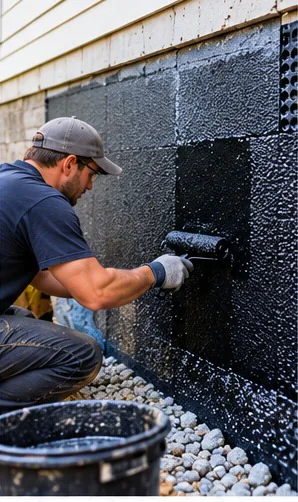
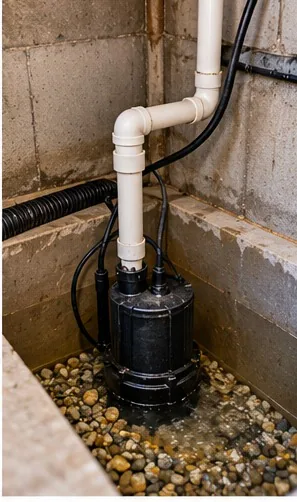
Illustrative images of drainage methods. Neither depicts this company's own work, and neither is typical of Texas residential construction.
Cost factors
Drainage work spans a wide range. Extending downspouts and clearing gutters is near-trivial. Regrading a yard is earthwork, priced by volume and access. A properly constructed French drain with a viable outfall is a substantial excavation job, and the cost scales with length, depth and how far the outfall is.
What is worth saying plainly: drainage correction is almost always cheaper than foundation repair, and skipping it is how homeowners end up paying for piers and then paying again. If a foundation proposal addresses the structure and says nothing about the water, ask why.